
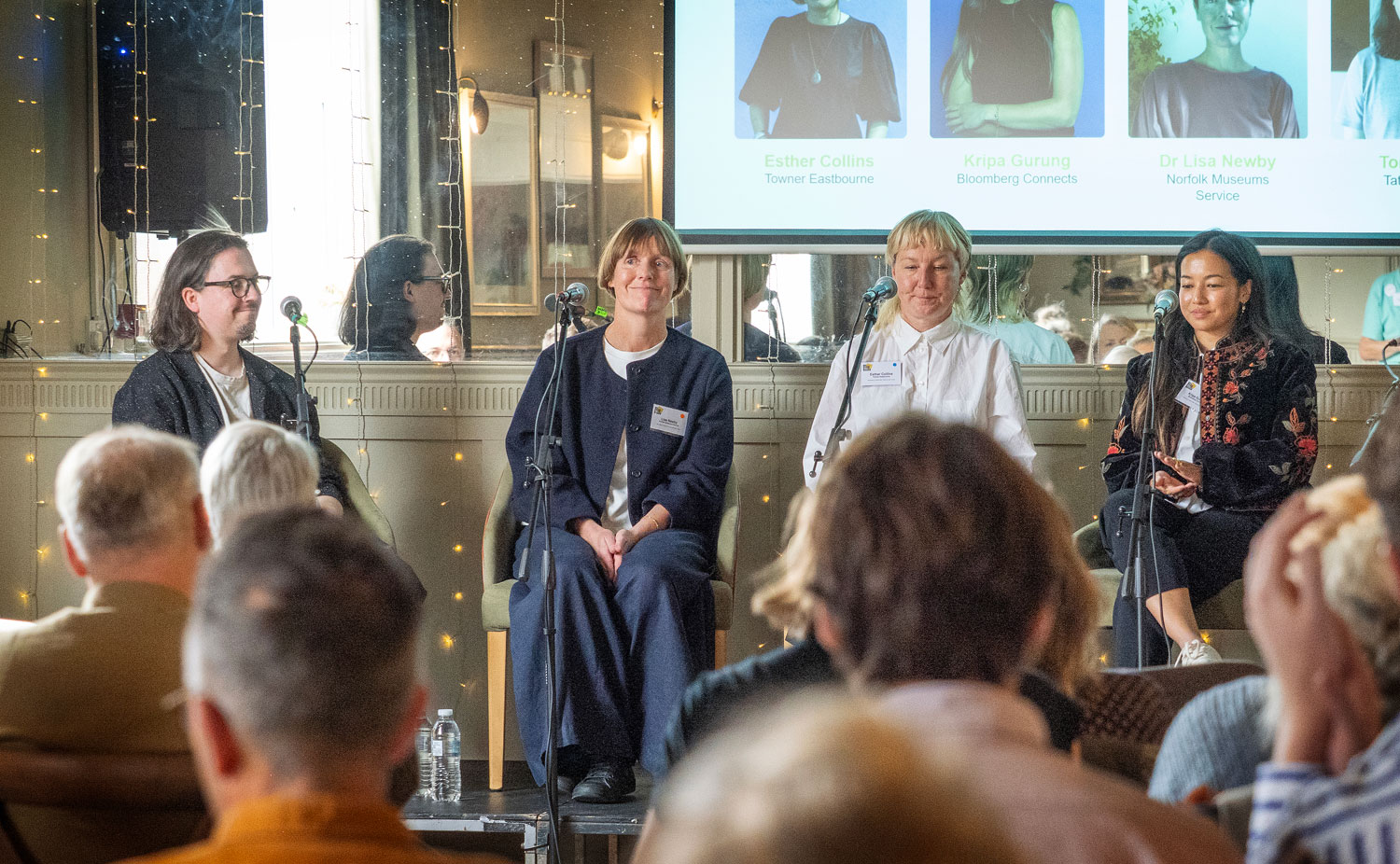
The afternoon panel “Theory into Practice of Decentralisation” was chaired by Dr Kimberly Foster (UCL) and featured:
- Tom Emery — Tate Liverpool
- Lisa Newby — Norfolk Museums Service
- Esther Collins — Towner Eastbourne
- Kripa Gurung — Bloomberg Connects
The discussion highlighted that decentralising the arts is not simply about taking exhibitions out of cities or bringing more people into galleries. It is about changing how cultural organisations work, whose knowledge they value, who makes decisions and where cultural opportunities are created.
For Cromer Artspace and the wider rural and coastal arts sector, the key challenge is to ensure that places outside major cultural centres are not just included in existing models, but have a meaningful role in shaping them.
1. Access is about more than free admission. Transport costs, unreliable public transport, expensive parking and the expectation to spend money in cafés or shops can all prevent people from visiting cultural venues.
2. Cultural organisations need to meet people where they are. Taking learning programmes and activities into community centres and familiar local spaces can help build relationships with people who may not ordinarily visit a gallery.
3. Local knowledge is a valuable cultural resource. Organisations can learn from existing community networks, interests and expertise rather than assuming that they must provide all the knowledge or lead every activity.
4. Decentralisation must be embedded across the organisation. It should not be left solely to education, learning or outreach teams. It needs to influence curatorial practice, programming, institutional policy and decision-making.
5. Institutions need to question their assumptions about audiences. Familiar venues can offer welcoming entry points, but encountering contemporary art may still feel unfamiliar. Curators need to consider how people are supported to look, interpret and engage.
6. Co-curation offers opportunities, but it takes work. Sharing decisions with communities can help make cultural programmes more relevant, although embedding this approach within established institutional structures can be challenging.
7. Digital tools can widen access, but they are not a complete solution. Platforms such as Bloomberg Connects can help people prepare for visits and explore artworks, but digital confidence, accessibility, staff capacity and the quality of content all matter.
8. Funding, time and skills are essential for change. Organisations often lack the digital expertise and resources to develop new approaches. Sustainable decentralisation requires investment, practical support and opportunities to share learning.
9. Creativity beyond major cities needs greater recognition. Cultural narratives and research should include artists and communities across rural and coastal areas, as well as smaller towns and places beyond established metropolitan centres.
10. There is no single model for decentralisation. Effective approaches depend on listening to communities, building partnerships, recognising local strengths and creating multiple ways for people to participate in culture.
At Cromer Artspace’s Curating Beyond the Frame symposium, a panel of cultural professionals explored what it really takes to make the arts more accessible — from tackling the cost of getting to a gallery to sharing decision-making power and recognising creativity beyond traditional cultural centres.
How do we make the arts accessible to more people? And what does meaningful access look like when the barriers are not simply about getting through a gallery door, but also about transport, money, confidence, resources and the way cultural organisations work?
These were some of the questions explored in the second panel at Cromer Artspace’s Curating Beyond the Frame symposium. Chaired by Dr Kimberly Foster, the discussion brought together Tom Emery from Tate Liverpool, Lisa Newby from Norfolk Museums Service, Esther Collins from Towner Eastbourne and Kripa Gurung from Bloomberg Connects.
Moving from the ideas explored earlier in the day to the practical realities of cultural work, the panel considered how institutions might challenge established ways of working and create more opportunities for people to engage with art on their own terms.
Access begins before the gallery door
For Tom Emery, one of the most persistent barriers is simply getting to a cultural venue. At Tate Liverpool, transport costs, expensive parking and unreliable public transport can all prevent people from visiting, particularly families travelling together.
Even when exhibitions are free, the overall cost of a visit can be significant. Visitors may also feel an expectation to spend money in the café or shop, adding another layer to the experience.
These practical barriers shape how people feel about a visit before they even arrive. If someone has spent a considerable amount of money and time getting to a gallery, they may arrive with particular expectations about what they should experience in return.
The discussion highlighted the need to think about access more broadly. It is not enough to offer free admission if the journey is unaffordable, the environment feels intimidating or visitors are unsure whether the experience is intended for them.
Finding culture where people already are
The panel also questioned the assumption that successful cultural engagement must mean bringing people into a gallery.
Esther Collins described how Towner Eastbourne has been exploring ways to work more closely with communities beyond its building. Some learning programmes alternate between the gallery and a community centre, helping to connect people who might otherwise use different spaces and services.
Eastbourne, like many towns, has significant geographical and economic divisions. Working in different locations offers opportunities to build relationships, understand local circumstances and bring people together.
For Esther, the challenge is to support the cultural life that already exists in communities without taking over or imposing an institution’s own priorities. This means recognising local knowledge and experience, and finding ways for a gallery to contribute to what is already happening.
It also means being flexible. Sometimes community groups want to work in their own spaces; at other times, they want to come into the gallery. Meaningful engagement requires being willing to move between the two.
This approach challenges the idea that culture is something held by an institution and delivered to an audience. Instead, it recognises that creativity is already present in communities, and that cultural organisations have as much to learn as they have to share.
Digital access: opening up new possibilities
Kripa Gurung brought a digital perspective to the discussion, drawing on her work with Bloomberg Connects, a free platform that enables cultural organisations to share guides, stories and multimedia content with audiences.
Digital tools can help people prepare for a visit, understand what to expect and explore a collection at their own pace. They can also help organisations reach audiences who may never visit in person.
However, digital access comes with its own challenges. Cultural organisations may lack the staff, time or specialist skills needed to develop digital content. Visitors may be unfamiliar with QR codes, reluctant to download an app or uncomfortable asking staff for help.
There is no single digital solution that works for everyone. The key is to understand the needs of different audiences and provide a range of ways to engage.
Kripa also emphasised the value of sharing knowledge between organisations. A solution that works for one institution may offer useful ideas for another, and a connected network can help smaller organisations learn from their peers rather than having to develop everything independently.
Digital platforms can also help decentralise cultural visibility. By bringing smaller regional organisations into the same network as internationally recognised institutions, they can help audiences discover work and places they might not otherwise encounter.
Funding needs to support change
Making cultural access more inclusive requires resources, but the panel questioned whether existing funding approaches always support the changes organisations want to make.
Kripa outlined how Bloomberg Philanthropies supports digital development through initiatives such as its Digital Accelerator programme, enabling cultural organisations to propose projects that respond to their own needs.
The wider discussion pointed to a familiar difficulty: organisations are often expected to deliver ambitious programmes while working within limited budgets and established structures. Reaching new audiences, developing partnerships and changing how teams work all require time, staff and sustained investment.
There is also a question of where responsibility for access sits within an organisation. If it is treated primarily as the job of an outreach or learning team, decentralisation risks remaining separate from core curatorial decisions, programming and strategy.
Lisa Newby argued for a more integrated approach. From her curatorial perspective, thinking beyond established hierarchies and geographical assumptions should be part of the work itself, rather than something added afterwards as an engagement activity.
Tom reflected on the difficulty of breaking down divisions between exhibition-making and learning teams, even when there is a shared desire to work differently. Institutional pressures, established responsibilities and the sheer demands of maintaining a busy programme can make change difficult to achieve.
The message was clear: inclusive access cannot depend on individual projects alone. It needs to be considered throughout an organisation, from funding and planning to programming and the visitor experience.
Who decides what audiences need?
One of the most important questions raised during the discussion was how cultural organisations make assumptions about their audiences.
It is common to hear institutions talk about what particular groups need, what they might enjoy or what would encourage them to participate. But these assumptions can become a barrier in themselves if the people concerned are not involved in shaping the offer.
Co-curation and collaboration offer alternative approaches. Rather than deciding everything in advance, institutions can invite communities to help select artworks, shape exhibitions and influence how cultural experiences are presented.
Tom highlighted the potential of co-curation to challenge traditional models of exhibition-making. Lisa spoke about the importance of questioning established curatorial habits and remaining open to different ways of working.
The principle is not that every project must suit everyone. Rather, it is about creating opportunities for different people to have a voice and to see their experiences reflected in cultural spaces.
As the panel explored, audiences are not a single, predictable group. People arrive with different interests, knowledge and expectations. Making art accessible means allowing for that diversity, rather than prescribing one way to look, learn or participate.
Recognising creativity beyond the city
The discussion returned repeatedly to the question of how creativity outside major cultural centres can be recognised and supported.
For Kripa, digital networks can help connect organisations through shared themes and stories, rather than simply grouping them by location or size. Marketing and partnership activity can give regional organisations greater visibility and help audiences discover the range of cultural work happening across the country and beyond.
Tom described how Tate Liverpool has sought to look beyond the most obvious centres of activity in the North West, including through research into regional art histories and opportunities for artists to present their work. This means looking beyond major cities to places that may be overlooked even within an otherwise well-connected region.
Lisa suggested that the starting point should be recognising creativity and its value wherever it occurs, rather than assuming that work made outside established cultural centres is somehow different or less significant.
This is central to the wider idea of decentralisation. It is not simply a matter of moving exhibitions from London to other places, or creating more outreach programmes. It involves questioning how cultural value is assigned, whose work receives attention and who gets to make those decisions.
There is no single solution
The panel did not offer a simple formula for making the arts more accessible. Instead, it revealed how closely connected the challenges are.
Transport, funding, digital access, institutional structures, curatorial practice and community relationships all influence who can participate in cultural life. Progress in one area may be limited if the others remain unchanged.
What emerged was the importance of listening, collaboration and a willingness to question established practices. Sometimes change means adapting an existing institution; sometimes it means working beyond its walls. Digital tools can create new connections, while local partnerships can build trust and reveal forms of creativity that might otherwise go unnoticed.
Above all, decentralisation requires time and resources, alongside a recognition that cultural life is already happening in many different places and in many different ways.
For Cromer Artspace, these conversations reinforce the importance of creating opportunities for people to encounter art beyond traditional cultural settings. They also raise a challenge for the wider arts sector: not simply how to bring more people into existing spaces, but how to change those spaces, practices and relationships so that more people feel they belong.
The work of decentralising the arts is ongoing. It begins with asking better questions, listening to different voices and being prepared to do things differently.