
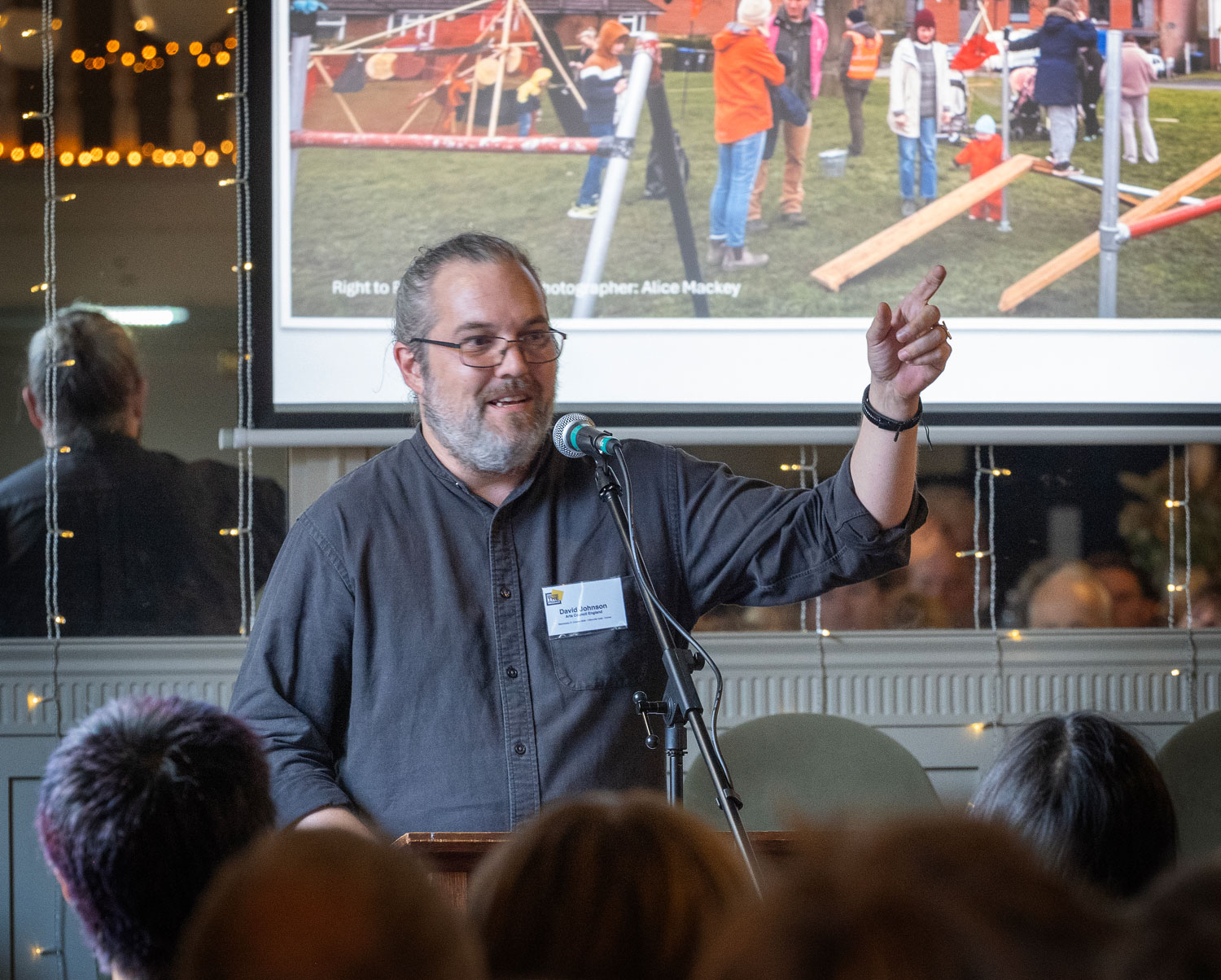
By David Johnson, Director of National Partnerships and Place, Arts Council England
Rural and coastal communities should not be treated as the edges of the cultural map. They should be recognised as places where creativity, experimentation and cultural leadership are already happening — and where the future of the arts can be shaped.
That is the thread connecting David’s personal story, his examples of practice and his argument for a more equitable approach to cultural investment.
1. Decentralisation is about power, not just geography. It means changing who makes decisions, whose voices are heard and how cultural organisations relate to the communities they serve — not simply moving activity out of cities.
2. Stop treating rural and coastal communities as places of cultural deficit. These communities already have creativity, talent, innovation and ambition. The challenge is to recognise, support and invest in what is happening there.
3. Access is about much more than the price of a ticket. Transport, confidence, disability, representation and whether cultural opportunities fit into people’s everyday lives all influence who participates.
4. Bring art to people, rather than expecting people to come to art. Cromer Artspace’s Bigger Picture project illustrates how taking artworks into public spaces can create unexpected encounters with art as part of ordinary life.
5. Decentralisation must be embedded throughout an organisation. It cannot be confined to outreach or education programmes. It needs to influence leadership, decision-making, partnerships, priorities and everyday practice.
6. Cultural investment must be sustainable and allow room to experiment. Smaller projects, proof-of-concept work and approaches that are simply “good enough” can be valuable. Organisations also need permission to stop doing things that no longer work.
7. Local leadership is often under-recognised. People working in rural and coastal communities frequently have the knowledge, relationships and ideas needed to make change happen, but their contribution and expertise are not always sufficiently acknowledged or supported.
8. Partnerships beyond the arts can unlock new opportunities. Working across sectors and with different organisations can build stronger foundations for cultural activity, share resources and connect the arts with wider community priorities.
9. Communities can learn from one another. Places facing similar challenges — even if they are geographically far apart — can share practical experience, build relationships and develop new approaches together. There is no single model that will work everywhere.
10. Ambition should not be limited by geography or finite resources. David’s personal experience growing up in South Shields, and his examples of cultural activity there, reinforce the point that places regarded as peripheral can be centres of creativity and leadership. Arts Council England’s challenge is to help address uneven investment and support cultural excellence everywhere.
There was something rather fitting about spending a day discussing the decentralisation of the arts in Cromer, by the sea. One of the things I took away from Curating Beyond the Frame was that places often described as being on the edge of England’s cultural life are not really on the edge at all. They are simply places viewed from a particular perspective.
Viewed from Cromer, the cultural map of England can look very different.
Throughout the day, we explored some difficult but important questions about power, place, representation and participation. What does decentralisation actually mean in practice? Who decides what gets funded, what gets commissioned and whose stories get told? And how do we ensure that cultural opportunities are shaped by the people and communities they are intended to serve?
I was struck by the honesty of the conversations. Nobody pretended that these questions had simple answers. That feels important, because decentralisation is not a destination we arrive at one day. It is an ongoing process, and one that requires us to keep questioning how we work.
It’s about relationships, not just geography
When people talk about decentralising culture, the conversation often starts with moving activity away from London or transferring decision-making to the regions. Of course, those things matter. But moving a decision-making structure hundreds of miles does not necessarily change how decisions are made.
The more fundamental question is who gets a seat at the table, and whether their voice carries genuine influence once they get there.
Community engagement is not the same as community influence. Inviting people into a conversation is valuable, but it is not the same as sharing decisions with them.
Artists, curators and cultural organisations bring essential skills and expertise. But communities hold knowledge too. They understand their histories, their neighbourhoods and the things that matter to local people. Some of the most exciting work happens when those different forms of knowledge come together.
At Arts Council England, we need to keep asking ourselves whether our own systems genuinely support that kind of shared decision-making. We have made progress towards decentralisation, but I think we still have more to do.
Let’s stop thinking about places in terms of what they lack
One thing I feel quite strongly about is the tendency to describe rural and coastal communities through a lens of deficiency. We hear about the lack of investment, infrastructure, venues and opportunities. Those challenges are real, and the uneven distribution of cultural investment needs to be addressed.
But that is not the whole story.
When I visit places across England, I see ingenuity. I see artists building networks, organisations developing partnerships and communities creating opportunities where none existed before. Often, people are finding ways to do extraordinary things with limited resources.
In some respects, the need to work differently has made these places experts in innovation. Not because somebody has written a policy document telling them to innovate, but because necessity has demanded it.
We should recognise that creativity is not concentrated in a handful of major cities. Excellence can emerge in a gallery, on a high street, in a village hall or in a former fishing community. It can be local and international at the same time.
Our job is not to tell places what they should become. It is to support them to realise their own ambitions, on their own terms.
What does access really mean?
We talked a lot about access during the symposium, and I think it is worth looking beyond the usual measures of admission prices and physical access to buildings.
For some people, access starts with a very practical question: can I get there? Transport, unreliable public services and the cost of travelling can be significant barriers, particularly in rural and coastal areas.
For others, it starts with confidence. Does this feel like something for me? Do I understand what I am going to encounter? Do I see myself, my experiences or my community reflected in the work?
For children and young people especially, cultural opportunities can be much more accessible when they are part of everyday life rather than requiring a special journey or a considerable amount of effort.
That is one of the reasons I find Cromer Artspace’s Bigger Picture project so interesting. It begins with a different question. Rather than asking how people can find art, it asks how the artwork can find the people.
Running into a Rembrandt while nipping out for a coffee is a wonderful idea. The artwork appears in a familiar setting, without the expectation that somebody must visit a gallery or already feel comfortable in one. These encounters are free and available on people’s own terms, with digital interpretation providing another way to engage.
There is an important lesson here. Broadening participation is not always about creating more provision. Sometimes it is about redesigning how that provision reaches people.
Funding for the long term, and working differently
Of course, ambition needs resources. One of the recurring challenges for smaller organisations is the stop-start nature of project funding. It is difficult to build sustainable programmes when one project is finishing just as another funding application needs to be written.
I spent many years working in fundraising, and I cannot claim to have cracked that problem. But I do think we sometimes need to give ourselves permission to stop, take stock and ask what we can realistically sustain.
We do not have to make every idea perfect before putting it into the world. Sometimes a smaller, workable version of a project is enough to test an idea, demonstrate its value and establish a foundation for future development. We can build from there.
We also need to think more broadly about where investment might come from. Communities are dealing with interconnected challenges around health, education, housing and economic opportunity. Cultural organisations are often addressing some of those same issues, but we can end up fundraising separately for different parts of a much bigger picture.
What might happen if we had more conversations with partners beyond the cultural sector? Could working with local authorities, health services, education providers and other organisations help unlock different forms of investment and make better use of the resources already available?
Partnership is not simply a nice idea. Given the pressures facing local government and many cultural organisations, it is a practical necessity.
At Arts Council England, we are thinking about how place can inform funding decisions, including how strategic authorities and expertise from other areas of public policy might help us better understand local needs. We need to continue making sure that the way we distribute funding reflects the different circumstances and ambitions of the places we serve.
The people who make things happen
We should also recognise the importance of local leadership.
Much of the work that keeps cultural activity going happens away from the spotlight. It is done by people who build trust, make introductions, connect organisations and keep partnerships alive when funding applications are unsuccessful. They are the people organising meetings, maintaining networks and finding ways forward when things get difficult.
They are not always the people standing on a symposium platform, but they are essential to making change happen.
I see this in my own community in West Norfolk and the Fens, and I suspect many people reading this will know exactly who those people are in their own places. We need to do more to recognise and invest in them.
We also need to get better at learning across different communities. We often organise peer learning around geography, but the nearest place is not necessarily the most useful comparison. A fishing town in the north-east might have a great deal to learn from a fishing community in the south-west.
Creating opportunities to share experience across places with similar challenges, histories or ambitions can be hugely valuable. The conversations at Cromer were a good example of why those connections matter.
The future might arrive somewhere unexpected
I grew up in South Shields, a proud maritime town in the north-east. Some of my earliest experiences of culture came through free arts festivals and local music, often produced with very little public subsidy and limited involvement from national organisations.
Today, the town has the National Centre for the Written Word at South Shields Library, alongside a Creative People and Places programme supporting local cultural activity and collaboration. It is an example of how cultural ambition can become part of a place’s identity and future.
That experience has stayed with me. Places that have sometimes been overlooked can be where interesting ideas emerge first. Innovation does not always come from the centre, and leadership does not always come from the places we expect.
For Arts Council England, our ambition must be to address uneven investment and support cultural excellence everywhere. Rural and coastal communities do not need saving by anybody. They deserve the same opportunities to realise their cultural ambitions as any other part of the country.
Resources will always be finite. But finite resources should not mean finite ambition.
Three things to take away
I ended the symposium by encouraging everyone to take three things away from the day.
First, a partnership: a conversation or relationship worth continuing and investing time in.
Second, one change to your own practice: something you will do differently as a result of what you have heard. It does not have to be a ten-year strategy or a sector-wide solution. One practical change is a good place to start.
And third, a question that remains unresolved. The future of culture will not be shaped by people who believe they already have all the answers. It will be shaped by those who remain curious enough to keep asking better questions.
I hope the conversations at Cromer continue well beyond the event itself. It is easy to leave an inspiring day full of ideas, only to return to the pressures of everyday work and find that there is little time to act on them. We need to make space to think, build relationships and turn discussion into action.
I came away from Cromer encouraged by the ambition, honesty and determination I heard throughout the day. Rural and coastal communities are places of creativity, experimentation and leadership. They have stories worth telling, ideas worth sharing and approaches from which the whole cultural sector can learn.
At Arts Council England, we want to work alongside the artists, organisations, local leaders and communities making that happen. We do not have all the answers, and we should not pretend that we do. The future we want to build can only be built together.
Perhaps that is the most important lesson from discussing decentralisation by the sea: places that look peripheral from one viewpoint can look very different from another. Sometimes the future of culture arrives first in places others have overlooked.