
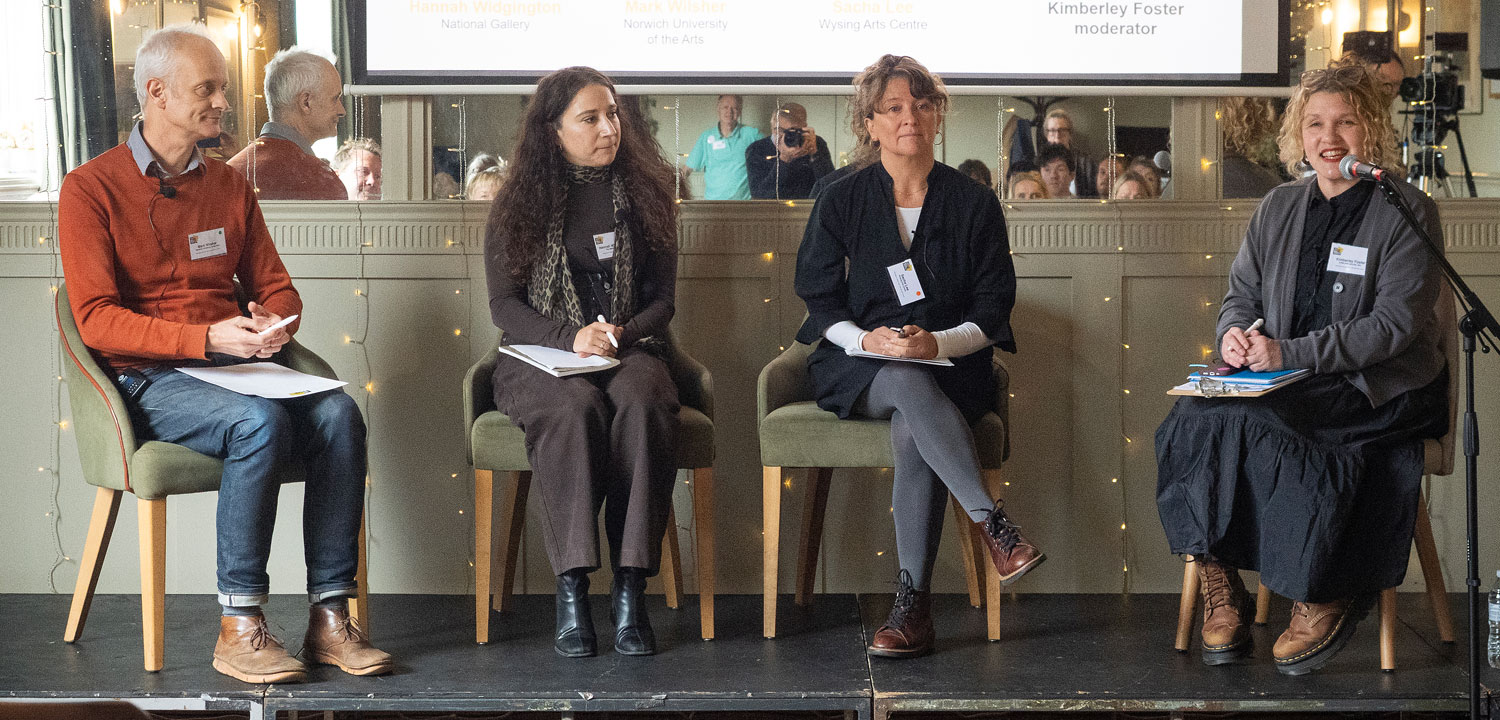
Morning panel: moderated by Dr Kimberly Foster (UCL) with Mark Wilshire (Norwich University of the Arts), Hannah Widgington (National Gallery), and Sacha Lee (Wysing Arts Centre).
The central message: Decentralising the arts means creating the conditions for people and communities to shape their own cultural lives. It requires agency, relationships, shared decision-making and a willingness to challenge established models — not simply moving existing cultural provision from one place to another.
Here are the top 10 points raised in the Curating Beyond the Frame panel discussion, distilled from the speakers’ contributions.
1. Decentralisation is about more than geography. It is not simply moving art out of London or taking exhibitions to rural and coastal areas. It means changing how cultural decisions are made, who has influence, and how art is experienced.
2. Change starts with individual agency. Artists and individuals can initiate cultural activity without waiting for institutional approval or funding. Small, self-organised projects can become the starting point for wider cultural networks.
3. Relationships are the foundation of a thriving arts scene. Conversations, connections and collaboration create the context in which ideas develop. In rural areas, these networks may need to be actively nurtured rather than relying on the critical mass found in cities.
4. Rural and coastal communities already have creativity and cultural value. Creativity is not confined to professional artists or established arts organisations. The example of a retired engineer grafting different apple varieties to represent his family showed how creative expression can emerge in everyday life.
5. Decentralisation must involve sharing power, not simply delivering culture. Taking collections or exhibitions into communities is most meaningful when local people help shape what is presented, how it is presented and what it means to them.
6. Institutions need to challenge their own assumptions and established practices. Organisations should question whether traditional exhibitions, venues and ways of working are reaching the people they intend to serve. Sometimes meaningful change requires stopping familiar activities and trying something different.
7. Participation should be flexible and inclusive. There is no single audience, and people engage with art in different ways. Some want to look quietly; others want to discuss, play, make or contribute. Successful engagement offers different ways in without imposing expectations.
8. Funding and institutional support matter, but can also constrain. Funding can provide recognition, resources and sustainability, yet it can bring priorities that conflict with an organisation’s values. The challenge is to secure support without losing creative independence and the freedom to experiment.
9. Cultural impact cannot be measured by footfall alone. Deep relationships, a sense of belonging, unexpected encounters and ideas that stay with people can be more significant than attendance figures. The panel questioned whether conventional measures adequately capture these longer-term effects.
10. Small, unexpected encounters can transform communities. Examples included a neighbourhood-wide yard sale, a playful sweet-shop installation, schoolchildren designing socks and communities selecting artworks for a public trail. These projects created connections, encouraged participation and helped people see familiar places differently.
What does it really mean to decentralise the arts? At Cromer Artspace’s Curating Beyond the Frame symposium, a panel of artists, educators and arts professionals explored how cultural power can move beyond established centres — and why meaningful change begins with people, relationships and the freedom to do things differently.
Decentralisation is a word we hear increasingly in discussions about culture. But what does it mean in practice? Is it about moving exhibitions out of London, distributing funding more widely, or changing who gets to make decisions about the arts?
At Cromer Artspace’s Curating Beyond the Frame symposium, moderator Dr Kimberly Foster, artist and lecturer at UCL, invited three panellists to explore these questions: Mark Wilshire of Norwich University of the Arts, Hannah Widgington of the National Gallery, and Sacha Lee of Wysing Arts Centre.
Their conversation suggested that decentralisation is not simply a matter of geography. It is about agency, relationships and the willingness to challenge established assumptions about where art belongs, who it is for and whose voices matter.
Beyond moving art out of London
For Hannah Widgington, whose role at the National Gallery involves taking its collection to audiences across the UK, decentralisation means moving beyond the institution’s traditional home and working with communities to discover what art might mean to them.
That is more than transporting familiar artworks into new locations. It means working in partnership with local museums, galleries and community organisations, allowing local knowledge and perspectives to shape how the collection is presented.
It also means challenging assumptions about where art should be encountered. Why should people always have to visit a museum? Art can appear in streets, libraries, shopping centres and other places where people already spend their time.
Crucially, this should not be a one-way relationship in which a major institution arrives with something to offer and expects local people to receive it. There is knowledge, creativity and experience on both sides. The opportunity lies in bringing them together.
Sacha Lee, Deputy Director of Wysing Arts Centre, highlighted another complication: decentralisation can still operate within frameworks that impose their own priorities.
Regional funding may offer opportunities for rural organisations, but it can also come with expectations shaped by wider economic or political agendas. For an organisation committed to giving artists the time and space to experiment, those expectations can create tensions.
The challenge is to make use of new opportunities without losing sight of the values that make an organisation distinctive.
Change begins with people
Mark Wilshire approached decentralisation through three interconnected ideas: agency, conversation and audience.
Agency is the ability to make things happen — to develop ideas, create opportunities and shape the cultural environment around us. Conversation and relationships provide the context in which those ideas can grow. And audiences do not simply appear because an exhibition opens its doors: they need to be invited into the conversation and given opportunities to participate.
As Mark observed, these conditions often develop naturally in cities, where people, institutions and resources are concentrated. In rural and coastal areas, they may need to be actively cultivated.
That does not mean waiting for a major institution or funding body to give permission.
Mark described an artist in Ethiopia who began exhibiting work in her kitchen because there was no established art scene around her. When she found that critical discussion was missing, she began writing about the work herself. Gradually, she helped create the conversations and networks from which a wider art scene could emerge.
The lesson is simple: cultural activity can begin with very little money or infrastructure. It needs people with the energy and determination to get something started.
But the discussion also recognised the limits of relying on individual enthusiasm. Grassroots initiatives can depend heavily on a few people, leaving them vulnerable to exhaustion. Institutional support and funding can provide valuable recognition and help sustain activity over time.
The challenge is finding a balance between support and independence — allowing initiatives to grow without losing the freedom and imagination that made them possible in the first place.
Nor does every project need to last forever. Cultural life is dynamic. Initiatives emerge, change and sometimes end, creating room for new ideas and people to take their place.
Creativity is not confined to artists
One of the most striking examples came from Sacha’s work in the Fenland area, where she spoke to a volunteer at a community orchard. The man, a retired engineer, had grafted three different varieties of apple onto one tree, choosing them to represent his wife and children.
He might not have thought of this as an artistic act. But to Sacha, it was an extraordinary expression of creativity.
The story challenges the idea that creativity belongs exclusively to professional artists or happens only within designated cultural spaces. People are already making, imagining and expressing themselves in their everyday lives. The task is to recognise that creativity and create opportunities for it to be shared.
At Wysing, this thinking has informed a significant change in approach. The organisation stopped presenting gallery exhibitions and instead focused more deeply on relationships with communities, including young people.
An artist residency in a school in Huntingdon, for example, led pupils to design their own socks. The project became a way to explore expression, identity and the rules governing everyday school life.
It might seem a long way from a conventional exhibition. But it demonstrates how artistic thinking can enter people’s lives in ways that feel immediate, relevant and genuinely participatory.
Participation means sharing power
The panel questioned the assumption that making an exhibition socially engaging simply means adding workshops, activities or new technology.
Different people want different things from art. Some visitors want to encounter a painting quietly; others want to talk, experiment or make something themselves. There is no single audience, and no universal formula for participation.
What matters is creating different points of entry and listening to the people an organisation hopes to reach.
This may mean asking open questions rather than simply delivering information. It may mean involving communities in selecting artworks, designing exhibitions or deciding how their stories are told. It may even mean questioning whether an exhibition is the right format in the first place.
Wysing’s decision to move away from its gallery programme was partly prompted by the considerable effort required to produce exhibitions that attracted relatively few visitors. Rather than continuing because exhibitions were what an arts centre was expected to do, the organisation chose to explore other ways of working.
That decision also raised a wider question about how cultural value is measured. Attendance figures can tell us how many people came through a door, but they cannot fully capture the impact of a meaningful encounter, a new relationship or an idea that stays with someone for years.
Technology and innovative presentation can offer new ways to engage audiences, but they can also be expensive and reach fewer people than intended. Experimentation matters, but so does evaluating whether an approach actually works for the people it is meant to serve.
Small encounters can change a place
The panel concluded with examples of cultural activity creating unexpected connections.
Mark described organising the NR3 neighbourhood yard sale in Norwich. With no budget and organised through Facebook, it brings together around 220 participating households each year. Streets fill with people walking, talking and discovering their neighbourhood in new ways. For Mark, it is one of his most satisfying creative projects.
Sacha recalled a temporary sweet-shop installation in Winchester, combining theatre, storytelling and a playful encounter with an ordinary shopfront. Although the funded project eventually ended, it helped spark interest in a different kind of experience in the town.
Hannah shared the example of the National Gallery’s Art on Your Doorstep programme on the Isle of Wight, where local schoolchildren and community groups selected artworks for a public trail. Seeing people walking together, using trail maps and enjoying art in their everyday surroundings demonstrated what can happen when communities have a genuine stake in a project.
These examples were very different in scale and form. Yet all created opportunities for people to encounter something unexpected, spend time together and see their surroundings differently.
A more generous cultural landscape
By the end of the discussion, decentralisation seemed less like a single policy or programme and more like an ongoing practice: building relationships, sharing power, challenging assumptions and remaining open to change.
It can begin with an artist making something happen in a kitchen, a community coming together around an orchard, or an organisation deciding to stop doing something simply because it has always done it that way.
Institutions and funders have an important role to play in sustaining this activity. But they do not own creativity, and they should not be the only ones deciding what counts as culture or where it happens.
For rural and coastal communities in particular, decentralisation means more than bringing art from somewhere else. It means recognising the creativity already present, making space for local voices and supporting people to shape the cultural life of their own places.
As the discussion made clear, meaningful change does not always require an entirely new structure. Sometimes it begins by looking again at what is already there — and having the confidence to do things differently.