
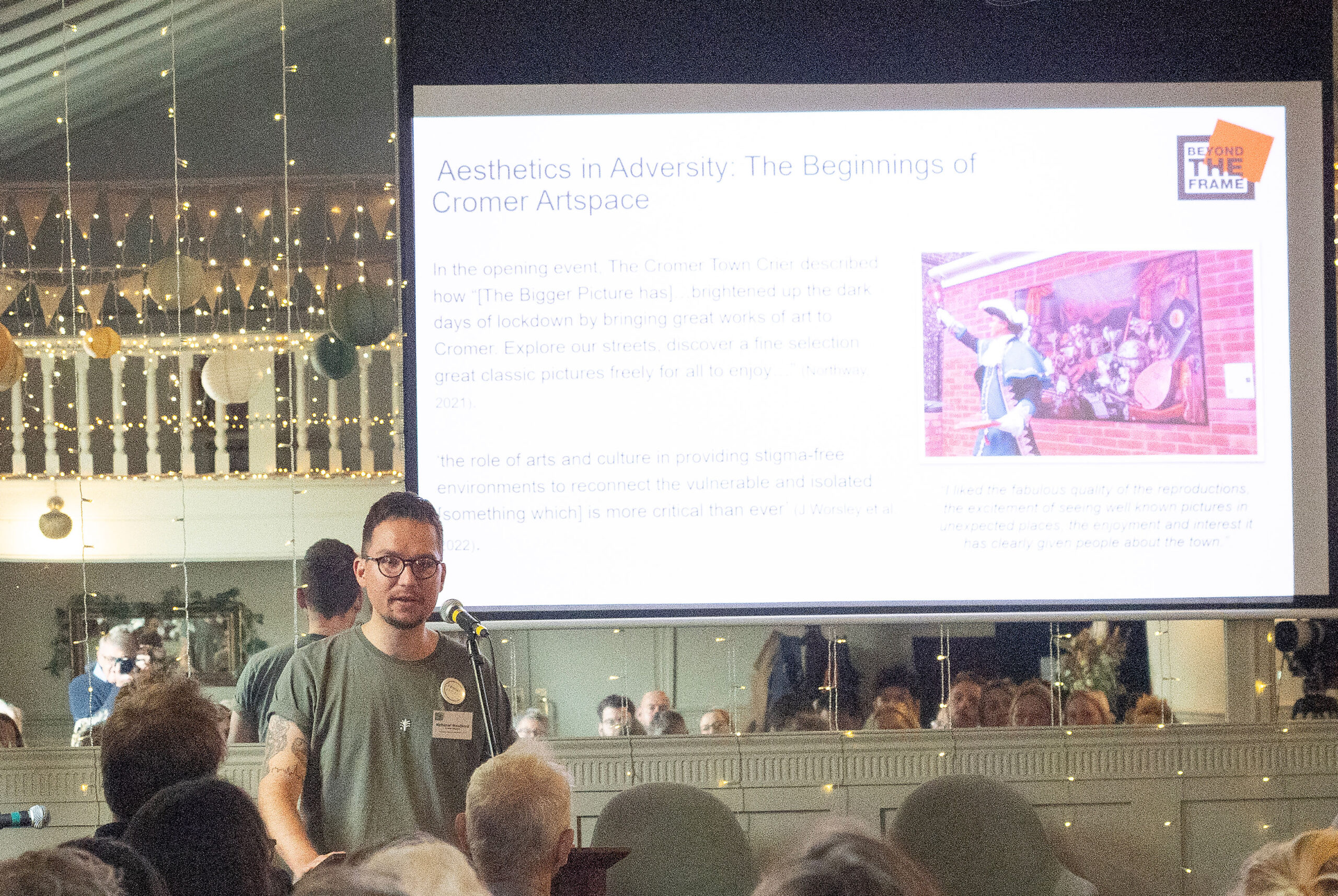
Nathaniel Woodward, Cromer Artspace
How Cromer Artspace is reimagining where art belongs, who it is for, and how we experience it.
What if encountering a great work of art didn’t require a visit to a gallery or museum? What if, instead, you could come across a Rembrandt while walking to the shops, discover a Monet on a shopfront, or find yourself stopping to look at a painting on your way to meet a friend for coffee?
This is the idea behind Bigger Picture, Cromer Artspace’s volunteer-led project bringing art into the streets of Cromer. By displaying large-scale reproductions of artworks on shop walls, windows and other everyday spaces, Bigger Picture challenges conventional ideas about where art belongs and who gets to experience it.
At its heart is a simple ambition: to make art part of everyday life, accessible to everyone, and not just those who feel comfortable walking through the doors of a gallery.
Bringing art to the streets
Bigger Picture began during the 2021 lockdown, when cultural venues were closed and many people were experiencing heightened isolation. The project responded to the absence of opportunities to engage with art locally by taking artworks directly into the community.
Starting with life-sized reproductions of out-of-copyright masterpieces, the project transformed familiar streets into an open-air exhibition. Art was no longer confined to a designated cultural space; it became part of the town itself.
This approach was about more than finding an alternative place to display paintings. It recognised that, particularly in rural and coastal communities, access to meaningful cultural experiences can be shaped by geography, economics and infrastructure. When opportunities are concentrated in cities and major cultural institutions, people living elsewhere can be left with fewer chances to encounter art.
Bigger Picture offers a different model. It brings art to the places where people already live, work, shop and socialise, without requiring a journey, a ticket or even a prior interest in art.
As one visitor put it:
“I love running into a Rembrandt when nipping out for a coffee.”
That response captures something essential about the project. Art becomes an unexpected encounter rather than a planned cultural activity: something that can interrupt an ordinary day, prompt a conversation or simply offer a moment of pleasure.
Challenging the idea that art is difficult
Access to art is not only a question of geography or cost. It is also about how people feel when they encounter it.
The gallery and museum remain important places for experiencing and understanding art. Yet these spaces can also carry associations of exclusivity, formality and social elitism. For people who feel unfamiliar with their conventions, even a gallery offering free admission can seem intimidating.
In Inside the White Cube: The Ideology of the Gallery Space, Brian O’Doherty examines how gallery environments influence the way art is presented and understood. The traditional gallery can make artworks appear precious, rare and separated from everyday life. For some visitors, this reinforces the impression that art is difficult to understand, or that a certain level of knowledge is required to appreciate it.
Bigger Picture questions these assumptions by removing the gallery barrier altogether. There is no threshold to cross, no expectation of prior knowledge and no prescribed way to engage. People can stop and look, walk past, return another day or discuss what they see with someone else.
This is a form of decentralisation that goes beyond moving cultural provision away from major cities. It challenges the idea that art must be experienced in a particular kind of building, through established cultural institutions, or according to familiar rules.
By placing artworks in the public realm, Bigger Picture opens up the possibility of encounters that are informal, spontaneous and personal. It allows art to become part of the shared environment of the town.
A project rooted in community
Bigger Picture has continued to evolve since its beginnings, while retaining its commitment to access and participation.
In 2023, Cromer Artspace worked with the National Gallery in London to bring reproductions of works by artists including Caravaggio, Claude Monet and Vincent van Gogh to the town. In 2024, the project developed a stronger community focus, working with local organisations and Cromer Museum.
Twelve frames were placed around the town, creating opportunities to explore Cromer’s history and local stories, including its wartime experiences. The project brought together art, heritage and community knowledge, demonstrating how public displays can invite people to engage not only with famous artworks but also with the place they call home.
The following year, Bigger Picture presented works from the National Galleries of Scotland, spanning paintings from the Enlightenment to the avant-garde.
In 2026, the project is working with Towner Eastbourne to bring a new selection of artworks to Cromer. These include works by Laetitia Yhap, Paul Carney and Emma Stibbon, among others. The selection reflects Towner’s collection and the contexts in which the works were originally presented, while allowing them to be encountered in a very different setting.
Each collaboration brings new artworks and perspectives into the town. Together, they demonstrate how partnerships with established galleries can help widen access to collections while creating distinctive experiences for local audiences.
Participation beyond the exhibition
For Cromer Artspace, making art accessible also means offering different ways to engage with it.
Alongside the street displays, Bigger Picture has developed a loan scheme through which artworks can be exhibited in non-profit spaces such as schools, gardens and charity hubs. This allows the project to reach beyond the town centre and into other community settings.
The project is also available through Bloomberg Connects, enabling people to explore the artworks and their stories digitally, wherever they are — even from their own sofa.
These different routes into the project recognise that access is not the same for everyone. Some people may encounter an artwork while walking through Cromer; others may engage through a community organisation, a school, a digital guide or a local event.
The aim is not to replace galleries and museums, but to expand the possibilities for experiencing art and to make those experiences more inclusive.
Rethinking where culture happens
The significance of Bigger Picture extends beyond the individual paintings displayed around Cromer. It asks a broader question about the relationship between culture and place.
Rural and coastal communities are often discussed in terms of what they lack: fewer venues, less infrastructure or greater distances from major cultural centres. But this perspective can overlook the creativity, knowledge and cultural life that already exist within these places.
Bigger Picture starts from the community itself. It is volunteer-led and grew from a local recognition that opportunities to encounter art should not depend on living near a major museum or gallery. Rather than waiting for people to travel to culture, it brings culture into their everyday environment.
This approach echoes a wider recognition of the role that arts and cultural activities can play in helping people connect, particularly where isolation is a concern. It also creates opportunities for people who might not ordinarily seek out an art exhibition to discover something unexpected.
The project does not assume that everyone will stop to look at every artwork, or that every encounter will lead to a deeper engagement with art. Its value lies partly in making those encounters possible in the first place.
When art is visible in public space, it becomes an invitation rather than an obligation. It can be enjoyed individually, shared with others or used as a starting point for conversations about art, history and the community itself.
Seeing the bigger picture
Bigger Picture began as a response to the isolation of lockdown, but its underlying purpose remains just as relevant: to rethink how art can be experienced beyond traditional galleries and museums.
By bringing artworks into the streets, working with community organisations, collaborating with national collections and creating alternative ways to engage, Cromer Artspace is helping to challenge the geographical and cultural barriers that can limit access to the arts.
Perhaps the most powerful measure of its success is the simplicity of the encounters it makes possible. A painting can become part of someone’s daily walk, a reason to pause in a busy street or a discovery that brightens an otherwise ordinary day.
To see the Bigger Picture is to recognise that art does not have to remain within a frame, a building or a particular cultural tradition. It can belong in the places where life happens — and it can belong to everyone.
Sometimes, all it takes is a walk through Cromer and the chance to run into a Rembrandt on the way to coffee.