
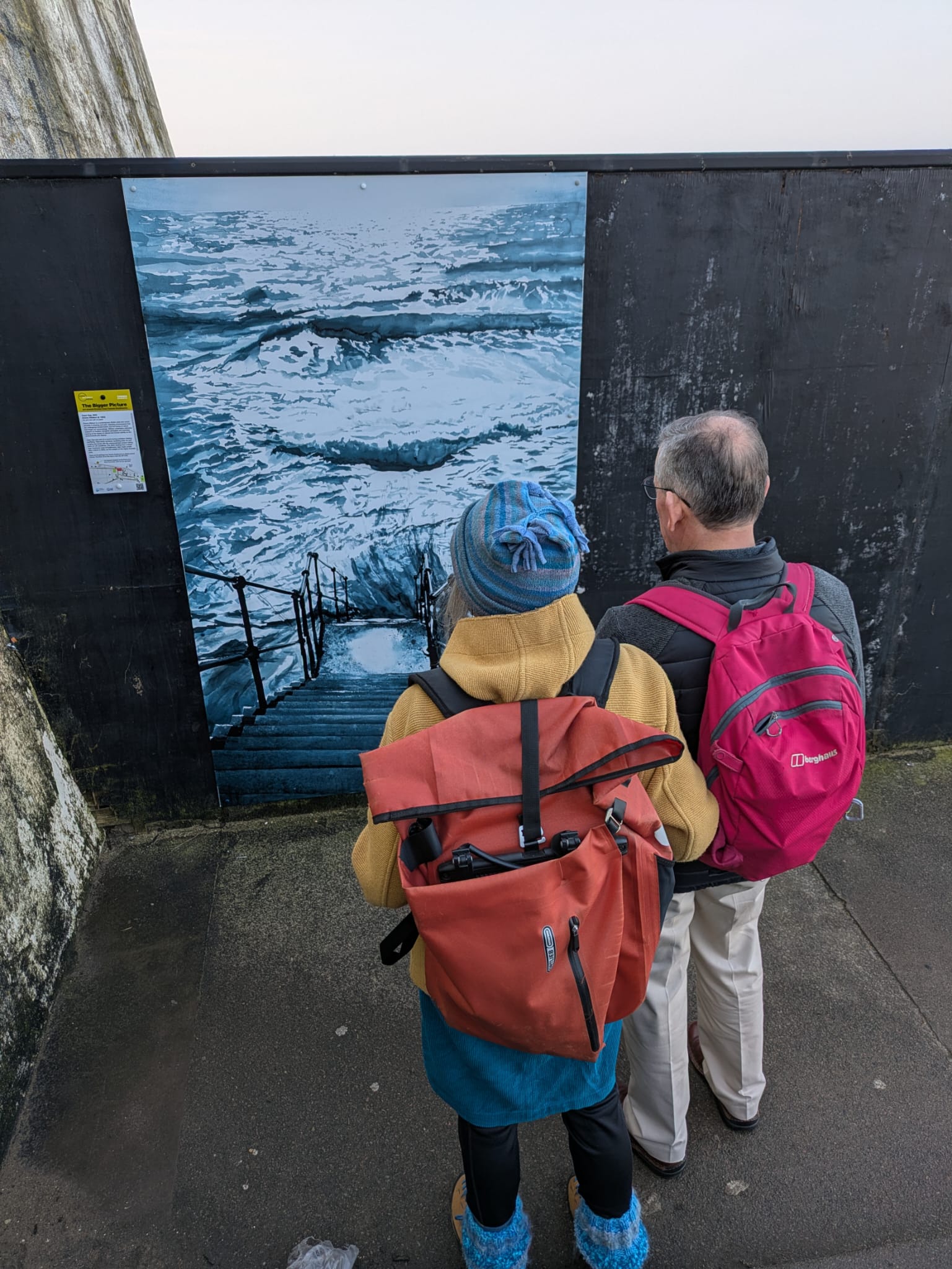
This post draws on an in‑depth interview with artist Emma Stibbon RA, whose work sits at the intersection of drawing, field research and environmental record. In the interview, she reflects on how she “almost always start[s]… with walking and drawing out in the field” and how many of the landscapes she works in “are changing beyond recognition in my own lifetime.” Her insights offer a powerful context for understanding Hope Gap, currently on display in Cromer as part of Towner 2026: The Bigger Picture.
Emma Stibbon RA has spent her career working where art, fieldwork and environmental record meet. Her practice takes her from Antarctica to Hawai‘i, from the High Arctic to the eroding cliffs of Sussex and Devon — always with a sketchbook in hand, always responding to landscapes undergoing dramatic change.
A practice shaped by witnessing change
Stibbon describes her work as beginning with “walking and drawing out in the field,” where the physical experience of weather, terrain and time becomes part of the work itself. Her recognition of environmental change has been gradual but undeniable: many of the places she has drawn “are changing beyond recognition in my own lifetime.”
Her long‑term preoccupation with glaciers and polar ice has taken her to both the Arctic and Antarctica, experiences she calls life‑changing.
Where art and science meet
Stibbon often collaborates with geologists and climate scientists to understand the forces shaping the landscapes she draws. For her Melting Ice | Rising Tides project, she worked with geohazards specialist Professor Dylan Rood, whose data on cliff‑retreat rates in Sussex and north Devon revealed “significant increase… over a very short timescale linked to rising sea levels and storm events.”
These conversations deepen her understanding — and create a dialogue between scientific evidence and artistic response.
Connecting polar ice to UK coastlines
Her recent touring exhibition at Towner Eastbourne and The Burton at Bideford made an explicit link between melting polar ice and the accelerating erosion of UK shores. Walking the coastlines, witnessing cliff falls, and seeing events like the collapse of the Hope Gap steps brought the global and local into sharp focus.
Her large‑scale works — watercolours, drawings and installations — place audiences at the edge of these shifting environments.
Drawing as witnessing
Although she uses photography, Stibbon says drawing forces a different kind of attention: “the act of drawing somehow imprints it on my memory.” Weather often leaves its own marks — rain, snow, salt — making the work a physical record of being present.
A commitment, not an agenda
Stibbon resists the label “activist,” but acknowledges a responsibility: “I am compelled to represent the changes I am witnessing.” Her work communicates both the beauty of the planet and the precariousness of the systems that shape it.
A connection to Cromer
Emma Stibbon’s Hope Gap is currently on display in Cromer as part of Towner 2026: The Bigger Picture, bringing her exploration of coastal change directly to North Norfolk audiences. Her work also appears in the group exhibition Sublime Landscapes.